Email Marketing for Beginners: The Complete Guide (2026)
Everything you need to start email marketing — list building, choosing an ESP, writing emails that get opened, automation basics, and free templates to get started fast.
Posted by
 Cory Trimm
Related reading
Email Components: Build Better Emails Faster
What email components are, why modular email design saves time, and how the EmailBits free component library works. With real examples of reusable email sections.
Welcome Email Templates: Examples & Best Practices
Free welcome email templates for SaaS, e-commerce, and newsletters. Plus best practices for subject lines, timing, and what every welcome email needs to include.
E-commerce Email Templates: Free Examples for Every Flow
Free HTML email templates for e-commerce — cart abandonment, order confirmations, shipping updates, win-back campaigns, and promotional emails. Copy-paste ready.
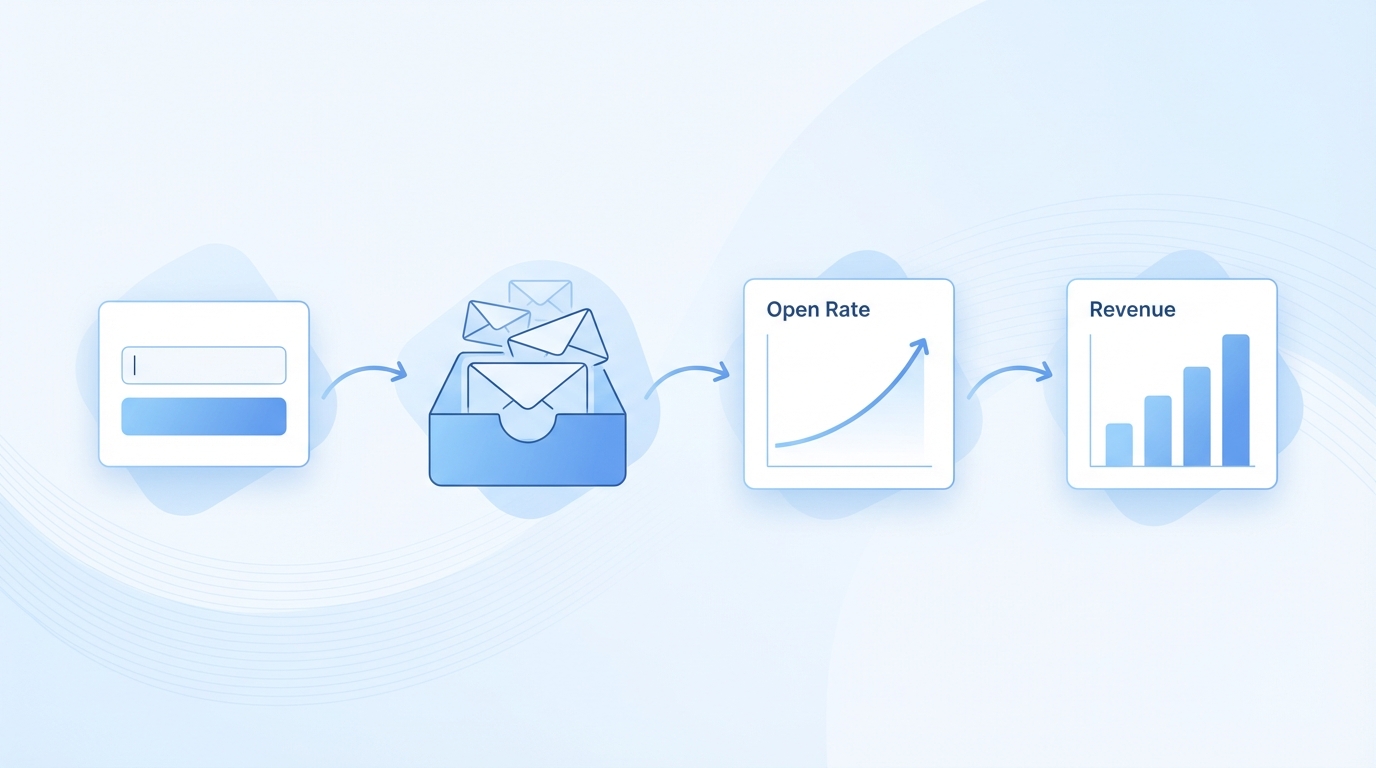
Email marketing consistently delivers the highest ROI of any digital marketing channel — commonly cited at $36–$42 return for every $1 spent. But the gap between brands that get those results and brands that don't usually comes down to basics: list quality, email structure, and a handful of automations that run without ongoing effort.
This guide covers everything you need to start email marketing from scratch — or to fix what's not working if you've already started.
Step 1: Build a List Worth Emailing
The quality of your email list matters far more than the size. A list of 500 people who genuinely want your emails will outperform a list of 5,000 people who barely remember signing up — in open rates, click rates, and deliverability.
Opt-in only
Never buy email lists. Never add people without explicit permission. Beyond the legal requirements (GDPR, CAN-SPAM, CASL), purchased lists have terrible engagement rates and damage your sender reputation — which affects deliverability for your entire list.
Give people a reason to subscribe
"Sign up for updates" is not a reason. Your signup form should answer one question: what does the subscriber get? A discount, exclusive content, early access, a free resource, or a specific cadence ("weekly tips on X"). The more specific and valuable the offer, the higher the conversion rate on your signup form.
Where to collect emails
- Website popup or slide-in: Triggered after a time delay or scroll depth. Converts well when paired with a specific offer.
- Footer or inline form: Lower conversion rate but catches intentional subscribers who seek it out.
- Content upgrades: A resource (checklist, template, guide) that's relevant to the page the visitor is reading.
- Checkout flow: For e-commerce, an opt-in checkbox at checkout. Pre-checked by default is not compliant in most jurisdictions.
Step 2: Choose an Email Service Provider (ESP)
An ESP handles list management, sending infrastructure, analytics, and automation. You should not send marketing email from a personal Gmail or Outlook account — it will be flagged as spam and damage your domain's sending reputation.
The right ESP depends on your business type:
- Mailchimp: Good for beginners. Free tier up to 500 contacts. Easy to use, integrates with most platforms.
- Klaviyo: Best for e-commerce, especially Shopify stores. Deep integration with store data for behavioral triggers and segmentation.
- HubSpot: Best for B2B and businesses with a CRM. Email is part of a broader marketing and sales platform.
- Kit (formerly ConvertKit): Best for creators, bloggers, and newsletter writers. Clean interface, strong automation for content-based sequences.
- ActiveCampaign: Strong automation features for complex sequences. Steeper learning curve, more powerful for experienced senders.
All of the above ESPs accept standard HTML in a custom HTML editor. You can copy any EmailBits template and paste it directly into any of them.
Step 3: Set Up Your Core Automations First
Before sending a single broadcast email, set up these three automations. They run automatically, require no ongoing effort once built, and drive the majority of email revenue for most businesses:
1. Welcome sequence
Triggered immediately when someone subscribes. At minimum: one email sent within 5 minutes of signup that confirms the subscription and delivers your lead magnet or discount code. A full welcome sequence is 3–5 emails over 7–10 days, introducing your brand, your best content, and your product.
2. Abandoned cart (e-commerce)
Triggered when a logged-in or cookied visitor adds items to a cart and doesn't complete checkout. Three emails: 1 hour, 24 hours, 72 hours. This sequence alone typically recovers 5–15% of abandoned carts.
3. Post-purchase follow-up
Triggered after a first purchase. Goals: reinforce the purchase decision, cross-sell related products, and ask for a review 7–14 days after delivery. Most businesses leave significant revenue on the table by not having this sequence.
Step 4: Write Emails That Get Opened and Clicked
Subject lines
The subject line determines whether the email gets opened. Keep it under 50 characters (to avoid truncation on mobile), be specific about what's inside, and avoid spam trigger words like "FREE!!!", excessive caps, or misleading previews.
The preview text (the grey text that appears after the subject line in the inbox) is the second thing subscribers read. Use it to extend the subject line — not to repeat it.
Body copy
Get to the point in the first sentence. Subscribers scan, they don't read. Use short paragraphs (2–3 sentences max), clear headings for longer emails, and a single focused message per email. Trying to accomplish too many things in one email usually accomplishes none of them well.
CTA
One primary CTA per email. The button should state exactly what happens when you click it — "Shop the Sale" beats "Learn More". Use a button, not a hyperlink, for the primary CTA — buttons have significantly higher click rates than inline text links.
Personalization
At minimum, use the subscriber's first name in the subject line or greeting. Always include a fallback: {{ first_name | default: 'there' }} in Klaviyo syntax, *|FNAME:there|* in Mailchimp. A broken merge tag ("Hi ,") damages trust more than no personalization at all.
Step 5: Understand Your Key Metrics
- Open rate: The percentage of delivered emails that were opened. Industry average varies widely by category, but 20–30% is a reasonable benchmark for marketing emails. Automation emails (welcome, abandoned cart) should be 40%+.
- Click-through rate (CTR): The percentage of delivered emails where a link was clicked. 2–5% is typical for marketing emails; higher for automation. Low CTR usually means a weak CTA or a mismatch between subject line promise and email content.
- Unsubscribe rate: Under 0.5% per send is healthy. Consistently high unsubscribe rates signal that you're sending to the wrong people, too frequently, or with irrelevant content.
- Spam complaint rate: Under 0.1%. Above 0.3% will cause deliverability problems with Gmail and Yahoo. If complaint rates are high, you have a list quality or permission problem.
- Deliverability / inbox placement: Not the same as delivery rate. Your email can be "delivered" to the spam folder. Monitor whether your emails are landing in the primary inbox, promotions tab, or spam.
Getting Started with Free Templates
The fastest way to start email marketing is to start from proven templates rather than designing from scratch. EmailBits has 600+ free HTML email templates covering every common use case — welcome emails, promotional announcements, newsletters, abandoned cart sequences, order confirmations, and more.
Every template includes both HTML (paste into any ESP) and JSX (for React Email and Node.js setups). No design skills required, no account needed to browse and copy. 225+ businesses and developers use EmailBits templates as their email starting point.
Frequently Asked Questions
How often should I email my list?
There's no universal right answer — it depends on your audience, content quality, and the expectations you set at signup. Weekly is a reasonable starting cadence for most businesses. More important than frequency: consistency. A predictable schedule (every Tuesday, every first of the month) builds habit and keeps your sender reputation healthy.
What's the best time to send email?
Tuesday through Thursday, mid-morning (9–11am in the recipient's timezone) are the most commonly cited optimal windows — but audience behavior varies. After your first few months, look at your own open rate data by day and time, then shift to what your audience actually responds to.
Do I need to know HTML to send email?
No. Most ESPs have visual editors that require no HTML knowledge. If you want more design control — or want to avoid the bloated HTML that some drag-and-drop builders output — you can copy a template from EmailBits and paste the HTML into your ESP's custom HTML editor. No coding required beyond copy and paste.
What's the legal minimum for marketing emails?
CAN-SPAM (US) requires a physical mailing address, a working unsubscribe mechanism, and no deceptive subject lines. GDPR (EU) requires explicit consent before sending and detailed record-keeping. CASL (Canada) has strict opt-in requirements. The safest baseline regardless of jurisdiction: only email people who explicitly opted in, always include an unsubscribe link, and include your company address in the footer. EmailBits footer components include all of this by default.